
Whether or not a new federal, provincial and First Nations pipeline gets built in Canada is still very much up in the air and predictably bogged down in politics.
But the energy industry is moving ahead with capacity increases and possibly one more expansion project based on existing pipelines.
Billions of dollars are being invested to move tens of millions more barrels annually to the United States.
This could have some impacts — and opportunities — for landowners along existing pipeline corridors.

RBN Energy LLC
The Race Is On – The Efforts to Develop More Crude Oil Pipeline Capacity From Alberta to Cushing
A few months ago, Enbridge unveiled its plans to expand its massive Mainline and smaller Express/Platte crude oil pipeline systems into the U.S. Midwest/Great Plains. We blogged about those plans, and followed up with a look at how the incremental volumes of Western Canadian crude on the Mainline and Express/Platte might move south from PADD 2 to where they’re wanted most: the Gulf Coast. In today’s RBN blog, we discuss efforts to piece together a more direct pipeline route from Alberta to Cushing and on to the Texas/Louisiana coast.
Two of the surest bets in the North American energy space these days are that (1) Western Canadian production of heavy crude oil will continue rising and (2) new pipeline takeaway capacity will be needed — sooner or later — to handle those increasing volumes. In Here, There and Everywhere, we discussed Enbridge’s plan to spend up to C$2 billion (US$1.5 billion) by 2028 to improve the efficiency and reliability of its 3.28-MMb/d Mainline pipeline system from Alberta to the Midwest. We noted that Enbridge is investing another C$1.5 billion (US$1.1 billion) by 2027 on a multiphase optimization project that will boost the system’s capacity by 150 Mb/d — and maybe more, if demand warrants. In addition, the company is looking to add up to 30 Mb/d of capacity to its 310-Mb/d Express-Platte pipeline system, which runs from Hardisty, AB, to Wood River, IL, just west of the Patoka, IL, crude oil hub.
More recently, in Take the Long Way Home, we looked at where those incremental barrels being piped south to PADD 2 (Midwest/Great Plains) would end up and, just as important, how they would get there. As we explained, most of those barrels will be heavy crude from the Alberta oil sands and, given that PADD 2 refineries can’t shoehorn much more low-API oil into their crude slates, almost all of the incremental imports will need to flow through the Midwest to the Cushing, OK, hub and on to refineries and export terminals along the Gulf Coast.
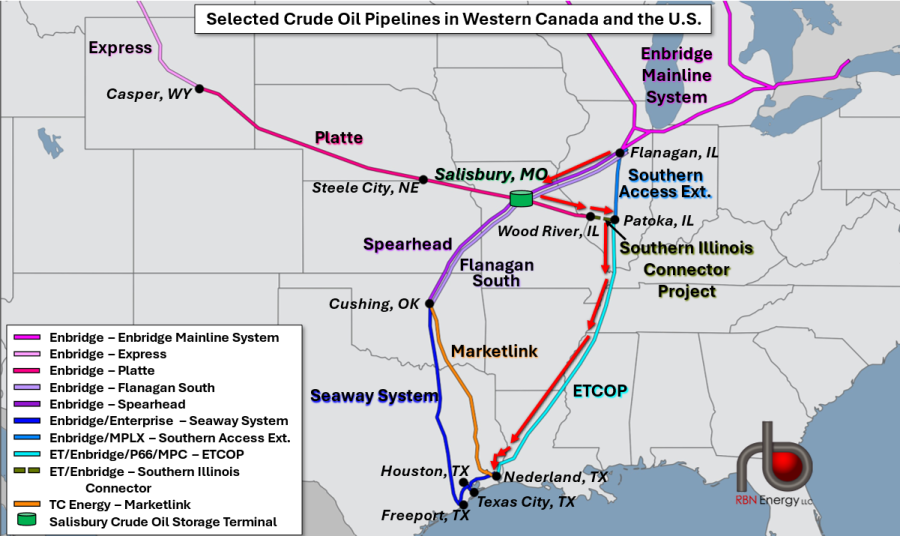
Figure 1. Selected Crude Oil Pipelines in Western Canada and the U.S. Source: RBN
We noted a few possibilities for enhancing the pipeline infrastructure south of the Mainline and Express/Platte systems, including a 100-Mb/d expansion of Enbridge’s 700-Mb/d Flanagan South Pipeline (light-purple line in Figure 1) from the Mainline’s Flanagan, IL, hub to Cushing.
Another possibility is Energy Transfer and Enbridge’s proposed Southern Illinois Connector project (dashed dark-green line), which would allow more heavy crude to flow southwest from Flanagan on Enbridge’s Spearhead Pipeline (dark-purple line), then east on its Platte Pipeline (dark-pink line) to Wood River, east from Wood River to Patoka (on the Southern Illinois Connector), and finally south on the Energy Transfer Crude Oil Pipeline (ETCOP; aqua line) to Nederland, TX. (Energy Transfer holds a 38% ownership interest in ETCOP and Enbridge owns a 28% stake — most midstreamers prefer to keep crude oil on company-owned pipelines to optimize efficiency and to earn fees each leg of the journey from production area to end user.)
Today, we shift our focus to another Enbridge-focused option we’ve heard is under very active consideration. It would make extensive use of existing pipelines between Western Canada and the Cushing hub, but would also require major capital investments to expand pipeline capacity along the routes.
Another Enbridge Route to Cushing
In addition to Enbridge’s Flanagan South expansion and Southern Illinois Connector plans we discussed above, we’ve heard the company is also well along in developing an Express/Platte-based route for moving more Western Canadian heavy barrels to Cushing. We are not privy to all the details, but our understanding is that the basic plan would be to increase the capacity of both the Express and Platte pipelines (light-pink and dark-pink lines, respectively, in Figure 2 below) and also make changes to Enbridge’s crude oil terminal (largest green tank icon) in Salisbury, MO, which has seven tanks with a combined shell capacity of 840 Mbbl. With those changes, and an enhanced interconnection between the Platte and Flanagan South pipelines at Salisbury, Enbridge would be able to transport substantial incremental volumes of heavy crude down Express, Platte and Flanagan South (light-purple line) to Cushing. (Note: Express’s current capacity is 310 Mb/d and Platte’s capacity is 164 Mb/d from Casper, WY, to Guernsey and 145 Mb/d from Guernsey to Wood River.)

Figure 2. Possible Enbridge Crude Oil Route to Cushing. Source: RBN
In what may have been a baby step toward this plan, Enbridge in December 2024 initiated an open season for shipper interest in 100 Mb/d of incremental capacity on Express from Hardisty to its connection with Platte in Casper. The open season ended in February, and while Enbridge has not commented publicly on it, the company said during its August 1 earnings call that it is looking to add up to 30 Mb/d of capacity to its Express-Platte pipeline system.
One more thing: The combination of what we hear Enbridge is planning would provide a lot of destination optionality. Incremental heavy crude could flow from Flanagan to Cushing on Flanagan South; from Flanagan to Patoka and then Nederland on Spearhead, Platte and ETCOP; or direct from Hardisty to Cushing on Express, Platte and Spearhead. Yet another option might be Express to Platte to Patoka to Nederland.
Other Alternatives, and What to Make of It All
We’ve also heard that there is at least one other option out there, one that would take Western Canadian barrels down a new, greenfield pipeline out of Alberta to feed expanded versions of existing pipelines through the eastern Rockies and Great Plains to Cushing. Details on that non-Enbridge alternative may be revealed in the coming months.
All this is a reminder that crude oil producers, shippers, marketers, midstreamers and other market participants in the U.S. and Canada are constantly assessing what the future will bring — there are a lot of moving parts and (lately, especially) a lot of uncertainty. As we said, though, it’s still a safe bet that Western Canadian heavy crude production will increase, new pipelines to Cushing and the Gulf Coast will be required, and midstreamers will be competing to provide the most efficient pathways for moving that incremental heavy crude to market.
Even with the Trump administration’s support for new oil-related infrastructure, it’s highly unlikely we’ll see another greenfield, Keystone XL-like mega-pipeline — they’ve proven to be time-consuming and costly, and there’s no guarantee it could satisfy state regulators, who still have a say in such things. Instead, we think it’s more likely we’ll see projects that make fuller use of interconnected pipeline systems, expand the capacity of existing pipelines, and, in some cases, call for the installation of new, parallel pipelines within existing rights of way that add several hundred Mb/d of capacity to those systems.
The mostly under-the-radar competition that seems to be underway between Enbridge and other midstreamers to develop a sort of Keystone XL Lite through the Rockies and Great Plains to Cushing will be playing out over the next few weeks and months. There’s no guarantee that any of these plans will advance to a final investment decision (FID) and it’s also possible more than one could proceed. The most likely outcome, though, may be a heated battle for barrels between highly skilled midstream contestants that results in one of their projects prevailing because it offered the simplest, most logical and most cost-effective solution. It will be fun to watch as these projects bubble to the surface.

Do you like this page?